
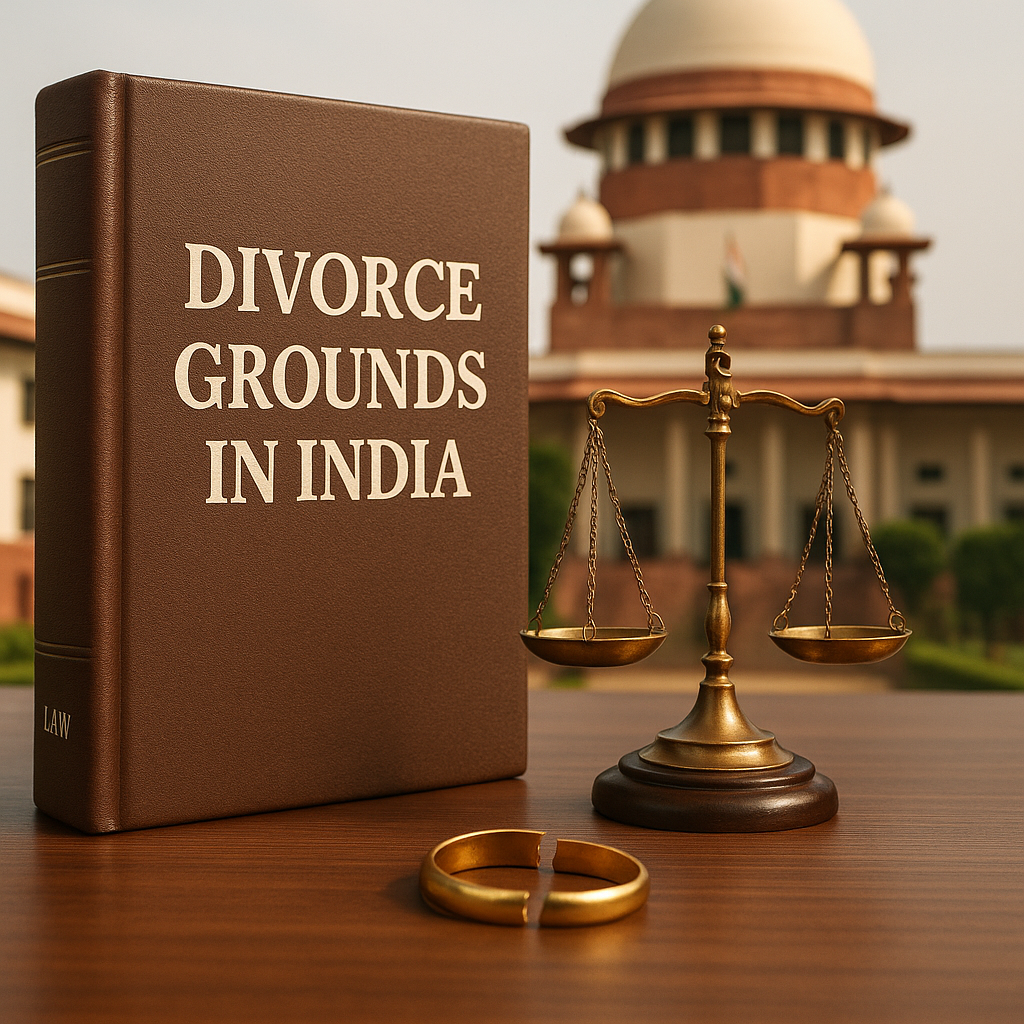
Grounds for Divorce in India:
A Complete Legal Reference
Understanding the recognized legal grounds for divorce in India is the essential first step before beginning any matrimonial proceedings. This guide walks you through every ground recognized under Indian personal and civil law — from cruelty and adultery to mutual consent — and explains how to file for divorce in India in clear, practical terms.
Why Knowing the Legal Grounds Matters
Divorce in India is not a single-track legal process. The applicable law, the required evidence, the timeline, and even the procedural steps all depend on which legal ground is invoked and which personal statute governs the marriage. Knowing the grounds does not just help you start — it determines the entire shape of your case.
India’s divorce framework is governed by multiple statutes. The Hindu Marriage Act, 1955 applies to Hindus, Buddhists, Jains, and Sikhs. The Special Marriage Act, 1954 governs civil or inter-religious marriages. Christians are governed by the Indian Divorce Act, 1869, while the Dissolution of Muslim Marriages Act, 1939 and the Parsi Marriage and Divorce Act, 1936 apply to their respective communities.
Despite this plurality, most statutes converge on the same core grounds. Understanding them prepares you to build a coherent, evidence-backed legal position — and to work productively with your legal representative from day one. If you want to understand the full procedural pathway, the step-by-step divorce process in India is a useful companion resource.
The Recognized Grounds: A Structured Overview
The following grounds are recognized under one or more of India’s major matrimonial statutes. The exact applicability depends on your religion and the law under which your marriage was solemnized.
Adultery
Voluntary sexual relations between a married person and someone outside the marriage. Either spouse may petition. Evidence — while circumstantial in most cases — must establish the adulterous relationship beyond reasonable doubt. Courts assess digital records, witness testimony, and corroborating circumstances.
Cruelty — Physical & Mental
One of the most frequently invoked grounds. Physical cruelty includes assault and bodily harm. Mental cruelty encompasses sustained humiliation, false criminal accusations, emotional neglect, and conduct that gravely injures the mental health of the petitioner. Indian courts have consistently held mental cruelty to be as legally significant as physical violence.
Desertion
When one spouse abandons the other without reasonable cause, consent, or intention to return. A minimum continuous period of two years of desertion is generally required before filing. The petitioner must demonstrate that the desertion was willful and unjustified — not merely a result of employment or circumstance.
Conversion of Religion
If one spouse voluntarily converts to a different religion, the other may seek dissolution of the marriage. This ground is available regardless of whether the conversion causes direct harm — the change in religious identity itself is treated as a material alteration to the marital bond under applicable statutes.
Mental Disorder
Incurable unsoundness of mind or a severe mental disorder that renders cohabitation unreasonable can justify divorce. The disorder must be continuous and of a degree that the petitioner cannot reasonably be expected to live with the affected spouse. Medical expert testimony is typically required.
Communicable Disease
A spouse suffering from a severe, communicable, or sexually transmitted disease that poses a genuine health risk to the other partner constitutes a recognized ground. The emphasis is on the ongoing nature of the condition and the objective threat to the petitioner’s health.
Renunciation of the World
If a spouse renounces worldly life and enters a religious order — formally becoming a sanyasi, monk, or equivalent — the other spouse is entitled to seek divorce. The renunciation must be complete and formal, demonstrating a clear, irreversible abandonment of marital duties.
Presumption of Death
Where a spouse has not been heard from for at least seven continuous years and is presumed dead, the other spouse may petition for divorce on this ground. Exhaustive efforts to trace the missing spouse are generally expected before the court accepts this presumption.
A Closer Look: Divorce on Grounds of Cruelty in India
Of all the grounds recognized under Indian matrimonial law, divorce on grounds of cruelty in India is among the most widely litigated — and also the most nuanced. The reason is straightforward: cruelty rarely leaves documentary evidence the way a financial fraud might. Its impact is felt in bedrooms, in kitchens, in silences — not always in hospital records or police complaints.
The Supreme Court of India has clarified that mental cruelty as grounds for divorce under the Hindu Marriage Act does not require physical injury. A sustained pattern of behavior that causes reasonable apprehension in the mind of the petitioner — that continued cohabitation is harmful to their mental health — is sufficient. This includes episodes of prolonged silent treatment designed to isolate, repeated public humiliation, baseless allegations of infidelity, or financial deprivation as a tool of control.
Proving mental cruelty requires a carefully constructed evidentiary narrative. Courts look for consistency of conduct over time, not isolated incidents. Text messages, call records, witness testimony from close family or friends, and documented medical consultations for stress or anxiety all contribute meaningfully to such a case.
Key Legal Standard: What Courts Examine in Cruelty Cases
Indian family courts assess whether the alleged conduct would reasonably cause apprehension in the mind of the petitioner — rendering the continuance of the marriage injurious to health or safety. Both the gravity of individual incidents and the cumulative effect of repeated behavior matter in this determination.
Physical cruelty remains relevant in a significant proportion of cases. Violence, assault, physical threats, and endangerment of a spouse’s safety are taken with the utmost seriousness. Medical records, FIRs, shelter home records, and photographs serve as primary evidence in such situations.
Mutual Consent Divorce: Procedure and Conditions
When both parties have made a joint, informed, and uncoerced decision to end the marriage, the mutual consent divorce procedure in India offers the most dignified and least adversarial path forward. It is governed by Section 13B of the Hindu Marriage Act (and equivalent provisions in the Special Marriage Act and other statutes).
Conditions That Must Be Satisfied
While mutual consent is the most streamlined process, it still requires careful legal drafting to ensure that settlement terms are fair, enforceable, and in the best interest of any children involved. Poorly drafted consent terms can lead to disputes later — particularly around alimony enforcement. For context on what happens when an ex-spouse defaults on maintenance payments, see this guide on enforcing alimony when a spouse refuses to pay.
Alimony is often the most contested element even in otherwise amicable separations. Both parties frequently enter negotiations with very different expectations of what constitutes a fair settlement. Understanding how maintenance is calculated before entering negotiations gives you a meaningful advantage — including cases involving working or non-working spouses, which are addressed in detail at this resource on alimony calculation.
How to File for Divorce in India: What the Process Actually Involves
Knowing the grounds is only part of the equation. Understanding how to file for divorce in India — the documents required, the courts involved, and the procedural sequence — helps you plan realistically and avoid preventable delays.
Every divorce petition begins with an identification of the applicable statute and the most supportable ground. This is not an administrative formality — it is a strategic decision. The ground you choose determines the evidence you must produce, the court in which the petition is filed, the timeline you should expect, and the defenses your spouse may raise.
Core documents in virtually all divorce filings include the original marriage certificate, identity proofs, address proofs, photographs of the marriage, evidence supporting the chosen ground, and documentation relating to any children of the marriage. In cruelty cases, medical records, FIR copies, and witness affidavits supplement the petition. In desertion cases, evidence of abandonment — communications, absence from the matrimonial home, and lack of financial support — forms the factual backbone.
Once filed, notice is served to the respondent. In contested proceedings, the case moves through written statements, evidence affidavits, cross-examination, and argument. Courts frequently encourage mediation at interim stages, particularly where children’s welfare is at stake. For a structured breakdown of every procedural step, the complete step-by-step divorce process guide is an authoritative reference.
Additional Grounds Under Personal Laws
Beyond the core grounds, certain personal statutes provide community-specific provisions that can be of significant relevance depending on your circumstances.
Hindu Marriage Act — Additional Provisions for Women
Women married under the Hindu Marriage Act can additionally seek divorce if the husband contracted a second marriage (bigamy) prior to the commencement of the Act, or if the husband has been guilty of rape, sodomy, or bestiality since the marriage. A wife may also seek divorce if a decree of maintenance has been passed in her favour and the husband has failed to comply with it, or if the marriage was solemnized before she attained fifteen years of age and she has repudiated it after turning eighteen.
Dissolution of Muslim Marriages Act, 1939
A Muslim wife may petition for dissolution of marriage on grounds including the husband’s whereabouts being unknown for four years, failure to provide maintenance for two years, imprisonment of the husband for seven or more years, failure to perform marital obligations for three years, impotency at the time of marriage and continuing thereafter, insanity or leprosy or virulent venereal disease, and cruelty as specifically defined under Section 2(viii) of the Act.
Indian Divorce Act, 1869 (Christians)
Christian spouses may seek divorce on grounds of adultery, conversion from Christianity, unsoundness of mind for at least two years, incurable leprosy for at least two years, venereal disease in a communicable form for at least two years, cruelty, and desertion for at least two years. Historically, the grounds were asymmetric between husband and wife; amendments have progressively harmonized this.
If your marriage involved questions of religion, or if a prenuptial agreement was contemplated but not executed, reviewing the rationale and benefits of a prenuptial agreement may inform future decisions, even retrospectively in asset-related discussions during proceedings.
Realistic Timelines: What to Expect
One of the most common — and reasonable — concerns among people considering divorce is how long does divorce take in India. The honest answer depends entirely on the nature of the proceedings.
Expected Duration by Proceeding Type
These timelines can be shortened considerably when both parties cooperate in evidence disclosure, when court hearings proceed without adjournments, and when legal representation is consistent and well-prepared. Conversely, tactical delays by a respondent — refusing to accept notice, filing lengthy counter-petitions, or challenging jurisdiction — can extend proceedings significantly.
Child custody matters often run parallel to the divorce petition. Understanding the legal standards for custody determination, the role of the child’s preference, and interim custody arrangements helps parents plan without prolonged uncertainty. The full legal framework for child custody is covered at this dedicated resource on child custody in India.
Alimony continues to be a subject of confusion even after divorce decrees are issued — particularly around whether a wife’s remarriage terminates a prior alimony order. For a legally precise answer, this is addressed in the guide on whether remarriage terminates alimony.
Frequently Asked Questions
Have a Specific Situation in Mind?
Whether you are considering divorce on grounds of cruelty, exploring the mutual consent route, or need an experienced contested divorce lawyer in Delhi to assess your options — a direct conversation with a family law specialist is the most reliable way to understand where you stand.
Request a Confidential Consultation No obligation. Your information is never shared. Available Mon–Sat, 9 AM–7 PM IST.