
Author: Advocate Pyush Verma, Jurist Zone Law Firm
Last Updated: 13 October 2026
Cheque Bounce Case in India: Section 138, Legal Notice, Punishment and Recovery
Cheque bounce case in India arises when a cheque is dishonoured and the statutory conditions under Section 138 of the Negotiable Instruments Act, 1881, are satisfied. For CEOs, MDs, COOs, business owners, finance managers and international companies conducting business in India, understanding the legal deadlines, potential financial consequences, evidence requirements and recovery options is essential to managing payment disputes.
A dishonoured cheque can affect cash flow, supplier relationships, contractual obligations and commercial risk. The appropriate response depends on the reason for dishonour, the underlying debt, the documents available and the stage of the dispute.
TL;DR: What this cheque bounce case guide covers
- Legal requirements: When dishonour can result in proceedings under Section 138.
- Critical deadlines: Cheque validity, the 30-day demand-notice period, the 15-day payment window and complaint limitation.
- Financial consequences: Maximum punishment, fines, compensation and certain court-ordered deposits.
- Corporate liability: When companies, directors, partners and authorised signatories may face proceedings.
- Practical recovery: Evidence collection, legal notices, negotiation, complaints and civil remedies.
- Defence and risk: Security cheques, disputed debts, repayment, procedural defects and company-related disputes.
- Court proceedings: Summons, evidence, settlement, trial, appeals and enforcement.
- Business protection: Preventive controls to reduce cheque dishonour disputes and improve receivables management.
For a case-specific assessment of a commercial payment dispute, consult a Business lawyer through Jurist Zone.
1. What is a cheque bounce case under Indian law?
A cheque bounce case is a legal proceeding arising from the dishonour of a cheque when the requirements of Section 138 of the Negotiable Instruments Act, 1881, are fulfilled. Section 138 principally covers cheques issued towards discharge, wholly or partly, of a legally enforceable debt or other liability that are returned unpaid for insufficient funds or because the amount exceeds the arrangement made with the bank.
The legal framework is not limited to Section 138. Sections 118 and 139 concern statutory presumptions; Section 141 addresses offences by companies; Section 142 covers cognizance and complaint limitation; Sections 143–146 address aspects of trial and evidence; Section 147 permits compounding; and Section 148 concerns deposits in certain appeals against conviction.
A bank return memo is important evidence of dishonour, but it does not by itself establish every element of a criminal complaint. The creditor must also consider the underlying liability, presentation date, statutory notice, service and failure to pay within the prescribed period.
2. When does a dishonoured cheque become a Section 138 offence?
The usual statutory requirements include the following:
- The cheque was drawn by a person on an account maintained by that person.
- The cheque was issued towards discharge, wholly or partly, of a legally enforceable debt or other liability.
- The cheque was presented within its applicable validity period.
- The bank returned it unpaid for a reason covered by Section 138.
- The payee or holder in due course sent a written demand notice within the prescribed 30-day period.
- The drawer failed to pay the cheque amount within 15 days after receiving the notice.
- An eligible complainant filed a written complaint within the prescribed limitation period, subject to the court’s power to condone delay where legally justified.
The enforceability of the underlying liability is often the central issue in a contested case. A supplier who holds a dishonoured cheque should retain the purchase order, invoices, delivery records and account reconciliation to establish the commercial transaction.
A drawer who disputes liability should preserve evidence of repayment, adjustments, cancellation, defective performance, settlement or another legally relevant defence. The merits depend on the facts and the applicable statutory presumptions.
3. Cheque bounce case timeline: validity, notice and complaint
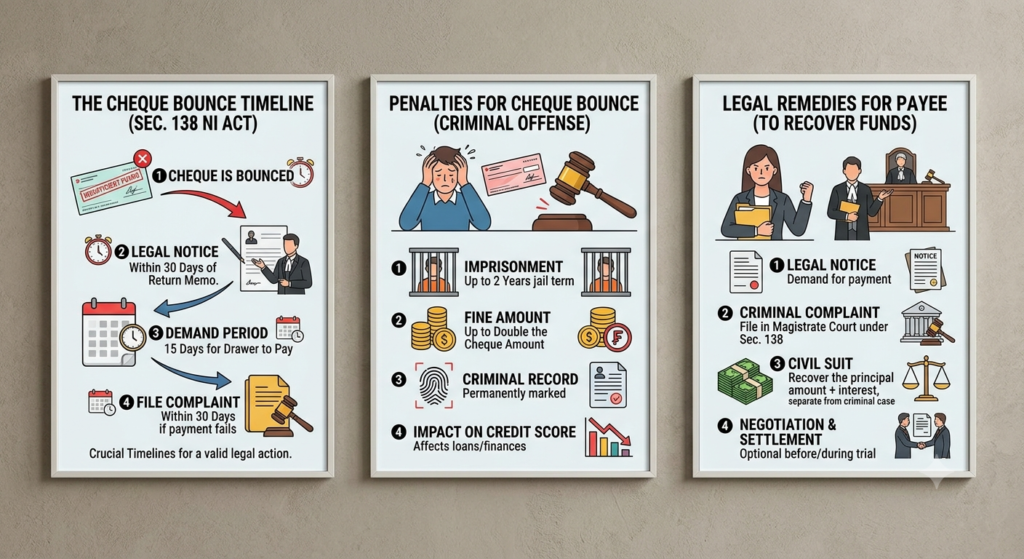
The deadlines under Section 138 and Section 142 must be calculated separately. The three-month cheque validity period is distinct from the 30-day notice period, the 15-day payment period and the one-month complaint limitation.
| Stage | General statutory position |
|---|---|
| Cheque presentation | Within the applicable validity period, generally three months from the date of the cheque |
| Demand notice | Within 30 days of receiving information from the bank about dishonour |
| Opportunity to pay | 15 days after the drawer receives the demand notice |
| Cause of action | Ordinarily arises after the 15-day payment period expires without payment |
| Complaint filing | Within one month of the cause of action arising, subject to legally permissible condonation of delay |
The Reserve Bank of India’s directions generally restrict cheque validity to three months. Section 138 prescribes the notice and payment requirements, while Section 142 governs the complaint and its limitation.
Example: how the deadlines work
Suppose a creditor receives information from the bank that a cheque has been dishonoured on 1 November. The creditor should calculate the 30-day notice deadline from the legally relevant date of receiving that information, rather than from the date the commercial transaction began.
If the drawer receives the demand notice, the 15-day payment period is calculated from receipt of the notice. If payment is not made, the creditor must then calculate the complaint limitation from the date the cause of action arises.
These dates are illustrative only. Actual calculations must account for the evidence of service, the relevant statutory rules, calendar dates and any applicable judicial interpretation.
What if a deadline is missed?
A notice sent outside the prescribed period can affect the Section 138 remedy. Section 142(1)(b), however, allows a court to take cognizance of a complaint filed after the ordinary limitation period if sufficient cause for the delay is shown.
A complaint filed before the cause of action has arisen can also be premature. The Supreme Court has emphasised that the statutory payment period must be respected before a complaint is instituted.
Practical rule: Record the cheque date, presentation date, bank information date, notice dispatch date, delivery date and proposed complaint date in a single timeline before initiating proceedings.
4. Why do cheques bounce, and does the reason matter legally?
The bank’s return reason should be assessed alongside the transaction and the statutory requirements. Different endorsements can lead to different legal questions.
| Dishonour reason | Legal issue to investigate |
|---|---|
| Insufficient funds | Whether a legally enforceable debt existed and the other Section 138 requirements were met |
| Exceeds arrangement | Whether the amount exceeded the permitted banking arrangement |
| Account closed | Whether the circumstances and statutory conditions support a complaint |
| Stop-payment instruction | Whether an enforceable liability remained unpaid despite the instruction |
| Signature mismatch | Whether execution, authority or the bank’s endorsement is disputed |
| Account blocked or frozen | The actual return memo, cause of restriction and underlying transaction |
| Refer to drawer | The precise endorsement and surrounding facts |
| Stale or expired cheque | Whether the cheque was presented within its applicable validity |
| Material alteration or technical defect | Whether the defect affects validity, execution or another element of the claim |
A stop-payment instruction or account closure does not automatically defeat a Section 138 complaint. Conversely, not every technical return creates criminal liability. The underlying obligation and statutory elements must be examined.
Can a creditor present the cheque again?
Re-presentation may be possible while the cheque remains valid, depending on the circumstances. A fresh dishonour can affect the analysis of the notice and limitation dates, but a creditor should not assume that every re-presentation automatically revives or extends every deadline.
Where a cheque has been returned for a technical reason, prompt coordination with the bank and a legal review of the relevant dates can help avoid unnecessary disputes.
5. What is the punishment for a cheque bounce case?
Section 138 provides for imprisonment of up to two years, a fine of up to twice the cheque amount, or both. These are statutory maximums; they are not automatic penalties in every complaint.
Other provisions can affect the financial position of the parties during proceedings.
| Provision | Financial consequence |
|---|---|
| Section 138 | Fine up to twice the cheque amount, imprisonment up to two years, or both |
| Section 143A | Interim compensation of up to 20% of the cheque amount in specified circumstances |
| Section 148 | Generally, a deposit of at least 20% of the trial court’s fine or compensation in certain appeals against conviction, subject to the statutory conditions and judicial interpretation |
| Settlement under Section 147 | Payment terms depend on the agreement and applicable court procedure |
| Civil recovery | Interest, costs and recoverable amounts depend on the contract, law and court’s decision |
Section 143A does not make interim compensation automatic in every case. It applies in specified procedural circumstances, including where the drawer pleads not guilty in a summary trial or summons case, or upon framing of charge in another case. The provision also contains repayment requirements if the drawer is acquitted.
Example: a cheque for ₹5 lakh
For a cheque amount of ₹5,00,000:
- Maximum fine under Section 138: ₹10,00,000.
- Potential interim compensation under Section 143A, where the provision applies: up to ₹1,00,000.
- Appellate deposit under Section 148, where applicable: generally at least 20% of the fine or compensation awarded by the trial court.
These amounts arise under different legal provisions. They should not be added together as an automatic total liability.
How much does a cheque bounce lawyer cost?
Legal fees depend on the location, amount in dispute, evidence, number of hearings, complexity and scope of representation. The cost of preparing a demand notice is different from the cost of drafting a complaint, conducting a contested trial or pursuing an appeal.
A business should request a written scope of work covering the proposed stages, professional fees, court-related expenses and any additional charges. A reliable legal-service page should not present invented nationwide fee averages as established facts.
6. Who can file a cheque bounce case?
A payee or holder in due course may file a written complaint where the statutory conditions are met. The complainant’s legal status and authority should be established before filing.
| Party | Relevant considerations |
|---|---|
| Individual creditor | Evidence of the underlying debt, cheque and statutory compliance |
| Proprietor | The legal identity of the payee and ownership of the claim |
| Company | Authorised representation, company records and proof of the commercial transaction |
| Partnership firm | The firm’s legal position, complainant authority and relevant partner liability |
| Holder in due course | Whether the person qualifies under the applicable statutory framework |
| Power-of-attorney holder or representative | Whether the complaint and evidence comply with the relevant legal requirements |
A company should preserve its authorisation documents, board resolutions where applicable, signatory records, invoices, ledger statements and supporting transaction documents. A representative’s authority should not be assumed merely because that person works for the company.
Which court has jurisdiction?
Section 142(2) contains specific rules governing the territorial jurisdiction of Section 138 complaints, including the circumstances in which the cheque is delivered for collection through an account or presented otherwise than through an account. The correct court should be determined from the statutory rule and the transaction’s banking details, not simply from the parties’ preferred location.
7. Can a company director be held liable?
Section 141 deals with offences by companies. Depending on the statutory requirements, proceedings may involve the company and persons who were in charge of and responsible for the conduct of its business when the offence was committed. The provision also addresses liability arising from consent, connivance or neglect in specified circumstances.
A director is not automatically criminally liable merely because their name appears in company records. The person’s role, the complaint’s allegations, the relevant dates and the applicable case law must be examined.
For commercial disputes, review:
- The identity of the drawer and the account holder.
- Who signed the cheque and under what authority.
- Whether the company itself is properly named.
- The responsibility of relevant officers at the material time.
- Whether the complaint contains the allegations required by law.
- Whether resignation, changes in control or other corporate events are legally relevant.
A company should maintain clear records of cheque-issuing authority, payment approvals, bank mandates, vendor reconciliations and internal escalation procedures. Such controls can help establish what occurred when a payment instrument was issued.
8. How should a creditor file a cheque bounce complaint?
A creditor should establish the facts and preserve evidence before selecting the appropriate remedy.
Step 1: Assemble the documentary record
Collect the original cheque, bank return memo, contract, purchase order, invoices, delivery challans, proof of services, ledger statements, payment history and relevant correspondence.
Step 2: Reconcile the liability
Confirm the amount outstanding on the relevant date. Identify any part-payments, credit notes, adjustments, disputed invoices or settlement terms that may affect the claim.
Step 3: Prepare and send the demand notice
The notice should demand the cheque amount and comply with the applicable statutory requirements. Retain the notice, dispatch receipt, tracking details and available evidence of service.
Step 4: Calculate the cause of action and limitation
Record the notice receipt date, the end of the 15-day payment period and the complaint limitation date. A lawyer should check the calculation before filing.
Step 5: File before the competent court
The written complaint must satisfy the applicable legal requirements and be filed before the court with jurisdiction. Company complainants should also ensure proper authorisation and supporting documents.
Step 6: Prepare for proceedings
Maintain an organised evidence file, identify relevant witnesses and preserve original records. The case may proceed through summons, evidence, cross-examination and adjudication, or may be resolved through a legally valid settlement.
9. What documents and evidence matter most?
A cheque bounce case can turn on evidence beyond the cheque itself.
Core documents for a complainant:
- Original cheque and bank return memo.
- Statutory demand notice and dispatch/service evidence.
- Agreement, loan record, purchase order or contract.
- Invoices, delivery records and proof of completed services.
- Ledger statements, bank records and account reconciliation.
- Emails, messages, acknowledgements and repayment promises.
- Company authorisation and corporate records, where applicable.
- Documents showing any settlement, instalments or part-payment.
For a commercial creditor, invoices without evidence of delivery or acceptance may leave important questions unanswered. A well-maintained record of the transaction, outstanding balance and communications can help address a debtor’s challenge to the liability.
10. How can the accused defend a cheque bounce case?
The accused may challenge an element of the statutory offence or raise a defence supported by evidence. Possible issues include repayment, absence of an enforceable liability, disputed execution, misuse of a cheque, procedural defects or incorrect identification of responsible persons.
Sections 118 and 139 create rebuttable presumptions in relevant circumstances. Once the applicable presumption is triggered, the accused may rebut it by raising a probable defence; a bare denial may not be sufficient.
The Supreme Court’s judgment in 2026 INSC 327 addressed the danger of rejecting a complaint at the pre-trial stage on a disputed question of enforceable debt where the statutory presumption under Section 139 had been triggered and the complainant had not been given the opportunity to lead evidence. The judgment illustrates why the procedural stage and the evidence available matter.
Potential defence issues include:
- The debt was already repaid or legally discharged.
- The cheque was issued for a liability that had not matured.
- The amount claimed does not match the enforceable outstanding liability.
- The cheque was lost, stolen or used without authority, supported by relevant evidence.
- The statutory notice or limitation requirements were not met.
- The complaint was filed by an ineligible complainant or in the wrong jurisdiction.
- The complaint does not satisfy the applicable requirements for company-officer liability.
- Reliable records contradict the claimed transaction or amount.
These are not automatic grounds for acquittal. Their significance depends on the facts, evidence and governing law.
11. Security cheques, blank cheques and disputed debts
A security cheque is not automatically outside Section 138. The key question is whether the secured liability had matured and remained legally enforceable when the cheque was presented, alongside the other statutory conditions.
In Sripati Singh v. State of Jharkhand, the Supreme Court considered the legal effect of security cheques. The case is relevant where a cheque was provided as security for a loan, commercial obligation or other transaction.
A blank signed cheque also requires fact-specific analysis. The fact that a cheque was blank when handed over does not, by itself, resolve whether the completed instrument can support a claim. The authority to complete it, the underlying obligation, the amount payable and any evidence of misuse must be assessed.
Common scenarios to address
| Scenario | Main legal question |
|---|---|
| Loan repaid before presentation | Is any enforceable liability still outstanding? |
| Part-payment made | What amount remained due, and how does the payment affect the cheque and claim? |
| Cheque issued for future supply | Had the relevant liability matured? |
| Disputed goods or services | What do the contract, delivery evidence and dispute records establish? |
| Cash loan | Can the transaction and legally enforceable liability be proved, and are other applicable laws relevant? |
| Cheque lost or stolen | Is execution or authority disputed, and what contemporaneous evidence exists? |
| Multiple cheques | What liability does each cheque represent, and what procedural approach is appropriate? |
| Drawer dies | What happens to the pending criminal proceedings and any separate civil recovery rights? |
A cash-loan dispute may raise issues beyond the NI Act, including the legality of the transaction and the evidence needed to establish it. A lawyer should review the facts rather than assuming that the cheque alone resolves every question.
12. What happens after a complaint is filed?
Section 143 provides for summary trial in qualifying cases, while the Act contains additional provisions concerning summons, evidence and proceedings. The actual path depends on the court’s orders and the case’s circumstances.
The process may include:
- Filing and judicial scrutiny of the complaint.
- Consideration of whether process should be issued.
- Service of summons and appearance of the accused.
- Plea and the applicable trial procedure.
- Evidence, affidavit evidence where permitted, and cross-examination as appropriate.
- Consideration of interim compensation where Section 143A applies.
- Judgment, followed by any appropriate appeal or other remedy.
Section 143 states that trials should be conducted as expeditiously as possible and that an endeavour should be made to conclude the trial within six months from filing. This is an endeavour specified in the statute, not a guarantee that every case will finish within six months.
Must the accused attend every hearing?
The requirement for personal attendance depends on the court’s orders, applicable procedural law and the circumstances. A lawyer may be able to seek an exemption or represent the accused where legally permitted, but attendance should not be ignored without an appropriate order.
Can a warrant be issued?
A court may take procedural steps to secure attendance when an accused fails to appear, subject to the governing law and circumstances. A warrant is not an automatic consequence of every dishonoured cheque or every missed hearing.
What happens after conviction or acquittal?
After conviction, the court may impose the legally permissible sentence or fine and may award compensation as appropriate. The accused may have an appeal or other remedy available under the applicable law, and Section 148 may become relevant to a deposit in certain appeals.
After acquittal, the consequences for any interim compensation, deposits and related civil claims must be assessed under the applicable provisions and court orders.
13. Can a cheque bounce case be settled?
Section 147 makes offences under the Negotiable Instruments Act compoundable, subject to the applicable procedure. Settlement may be considered before or during proceedings and, where legally permissible, at later stages.
A written settlement should specify:
- The total agreed amount.
- Payment dates and instalments.
- Interest or costs, if agreed.
- The consequences of missed payments.
- How the pending proceedings will be addressed.
- The documentation required once payment is completed.
Payment of the cheque amount after a complaint is filed does not mean that every procedural step automatically disappears. The parties should ensure that the appropriate court process is completed.
14. Cheque bounce case versus civil money recovery
A Section 138 complaint and a civil recovery proceeding have different legal purposes. The first concerns statutory liability for qualifying cheque dishonour; the second seeks recovery of a debt or other civil relief.
| Remedy | When it may be relevant |
|---|---|
| Section 138 complaint | Where the statutory requirements for cheque dishonour are satisfied |
| Civil recovery suit | Where a creditor seeks a civil decree for an outstanding debt |
| Summary suit under Order XXXVII CPC | Where the claim and supporting documents qualify for the summary procedure |
| Arbitration | Where a valid arbitration agreement covers the dispute |
| Negotiated settlement | Where parties can agree on payment, instalments and closure terms |
| Commercial dispute proceedings | Where the dispute qualifies under the applicable commercial-court framework |
A business should compare limitation, evidence, likely costs, jurisdiction and the relief sought before choosing a route. Parallel proceedings may be possible in appropriate circumstances, but a creditor cannot obtain double recovery of the same debt.
For an unpaid supplier invoice, the strongest strategy may involve reviewing the contract, delivery evidence, cheque, ledger and communications together rather than treating the dishonoured cheque as the only source of proof.
15. Special situations: questions creditors and businesses should not overlook
Can a legal notice be sent if the drawer refuses delivery? The legal effect depends on the address used, the mode of service, the postal record and the applicable law. Preserve the envelope, tracking history and any returned notice.
Can a complaint be filed after the drawer closes the business? Business closure does not automatically determine the outcome. The identity of the drawer, the account, the underlying liability and the statutory requirements must be examined.
What if the payee dies? The effect on a pending criminal complaint and the ability to pursue a civil claim depend on the applicable law, the stage of proceedings and the rights involved. Do not assume that criminal proceedings simply transfer to an heir.
Can a case be filed when multiple cheques are dishonoured? Each cheque’s underlying liability, statutory notice and limitation must be considered. The correct filing approach depends on the facts and applicable procedural provisions.
What if the cheque involves an international company? A foreign counterparty does not automatically remove an Indian transaction from Indian law. The place of the account, the contracting parties, the transaction documents, jurisdiction and service requirements should be reviewed.
Can the drawer travel abroad while a case is pending? The answer depends on court orders, bail conditions and the procedural circumstances. A pending case does not by itself establish a universal travel prohibition.
16. How businesses can prevent cheque dishonour disputes
Prevention starts with payment controls, documentation and early escalation.
- Verify the identity and authority of counterparties before extending credit.
- Use clear written contracts with payment dates, interest terms and dispute procedures.
- Maintain purchase orders, delivery records, invoices and acceptance evidence.
- Reconcile customer accounts regularly and record credit notes and part-payments.
- Set approval controls for issuing cheques and monitor payment commitments.
- Preserve correspondence concerning delayed payments, disputes and settlement proposals.
- Escalate missed payments promptly for commercial and legal review.
- Track limitation dates centrally rather than relying on informal reminders.
For international companies operating in India, local legal review should be integrated with accounts receivable, treasury and contract-management processes. The objective is to identify unpaid liabilities early and preserve the records needed to enforce contractual and statutory rights.
Conclusion: take a structured approach to a cheque bounce case
A cheque bounce case requires a fact-specific assessment of the enforceable debt, bank dishonour, statutory notice, limitation and evidence. For companies and business owners, a structured response can help preserve legal remedies, assess settlement opportunities and manage the commercial impact of unpaid obligations.
If your business has issued or received a dishonored cheque, arrange a legal assessment before choosing a notice, complaint, defense or recovery strategy. Jurist Zone’s Business lawyer services provides a starting point for discussing a commercial legal issue.
Frequently asked questions
1. How many days do I have to send a legal notice after a cheque bounces?
Section 138 requires the payee or holder in due course to send a written demand notice within 30 days of receiving information from the bank that the cheque has been dishonoured. The drawer then has 15 days after receiving the notice to pay the cheque amount.
2. What is the maximum punishment for a cheque bounce case in India?
Section 138 provides for imprisonment up to two years, a fine up to twice the cheque amount, or both. The actual outcome depends on the facts, evidence and court’s decision; the statutory maximum is not an automatic penalty in every case.
3. Can a company director be held liable for a cheque bounce case?
A director may be liable under Section 141 when the statutory requirements are met, including the applicable rules concerning responsibility for the company’s business or consent, connivance or neglect. Every director is not automatically liable merely because they hold office.
4. Can I settle a cheque bounce case after the complaint has been filed?
Yes. Section 147 of the Negotiable Instruments Act permits compounding of offences under the Act, subject to the applicable procedure. The parties should document the settlement, comply with its payment terms and complete any required court formalities.
Legal references
- Negotiable Instruments Act, 1881 — India Code.
- Reserve Bank of India directions on cheque validity.
- Supreme Court of India — 2026 INSC 327.
- Sripati Singh v. State of Jharkhand — Supreme Court of India, on security cheques and enforceable liability.
Legal information disclaimer: This article provides general information about Indian law and does not constitute an opinion on a specific dispute. The current statutory text, binding judgments, procedural rules and facts of the case should be reviewed before legal action is taken.